Main page content
Entity view (Content)
American Repertory Theatre at Harvard University
United States of America
Stravibase Fix

Entity view (Content)
Overview
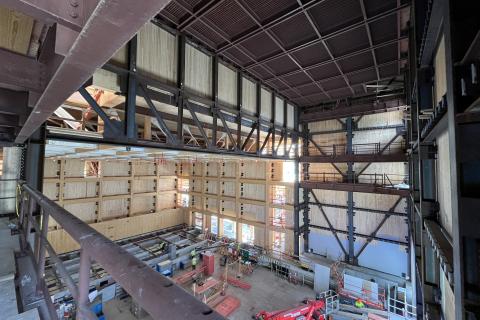
As part of an ambitious redevelopment project, the American Repertory Theatre at Harvard University was designed as a multi-use performance and academic facility constructed almost entirely from cross-laminated timber (CLT) mass timber. The building integrates theaters, rehearsal spaces, dance studios, classrooms, offices, and public areas within a vertically stacked program, creating exceptionally demanding acoustic conditions.
While performance venues inherently require strict control of vibration and structure-borne sound, this project introduced additional complexity due to the structural requirements of a large-scale timber building. Several building volumes required high levels of acoustic separation but could not be structurally isolated due to load paths, lateral stability requirements, and construction sequencing constraints.
In fully timber buildings, structure-borne sound can easily transmit through columns, beams, and other vertical elements, bypassing floor assemblies and isolated slabs. This risk was particularly critical where high-impact uses such as dance studios were located above public spaces and offices. Acoustic performance criteria developed by Charcoal Blue and structural stiffness requirements defined by LeMessurier introduced competing demands, requiring a solution that balanced acoustic isolation, structural continuity, and efficient construction.
Solution
To resolve these conflicting requirements, Nordic engaged CDM Stravitec to develop an engineered acoustic-isolation strategy that maintains structural continuity while limiting vibration and noise transmission.
CDM Stravitec collaborated closely with the design and construction teams to engineer a project-specific solution based on its Stravibase Fix elastomeric bearing technology. While Stravibase Fix systems are commonly used in base-isolation and vibration-control applications, this project required significant adaptation to suit a fully timber structural system and highly sensitive performance spaces.
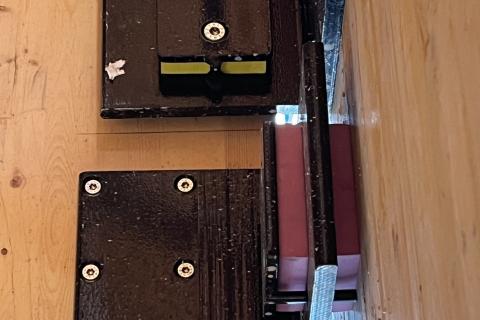
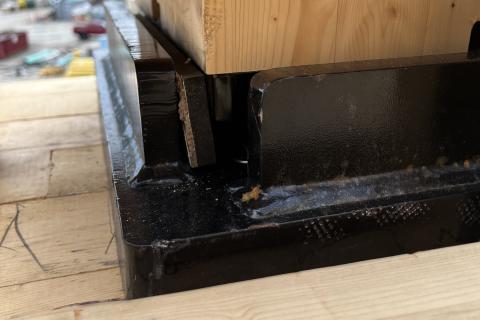
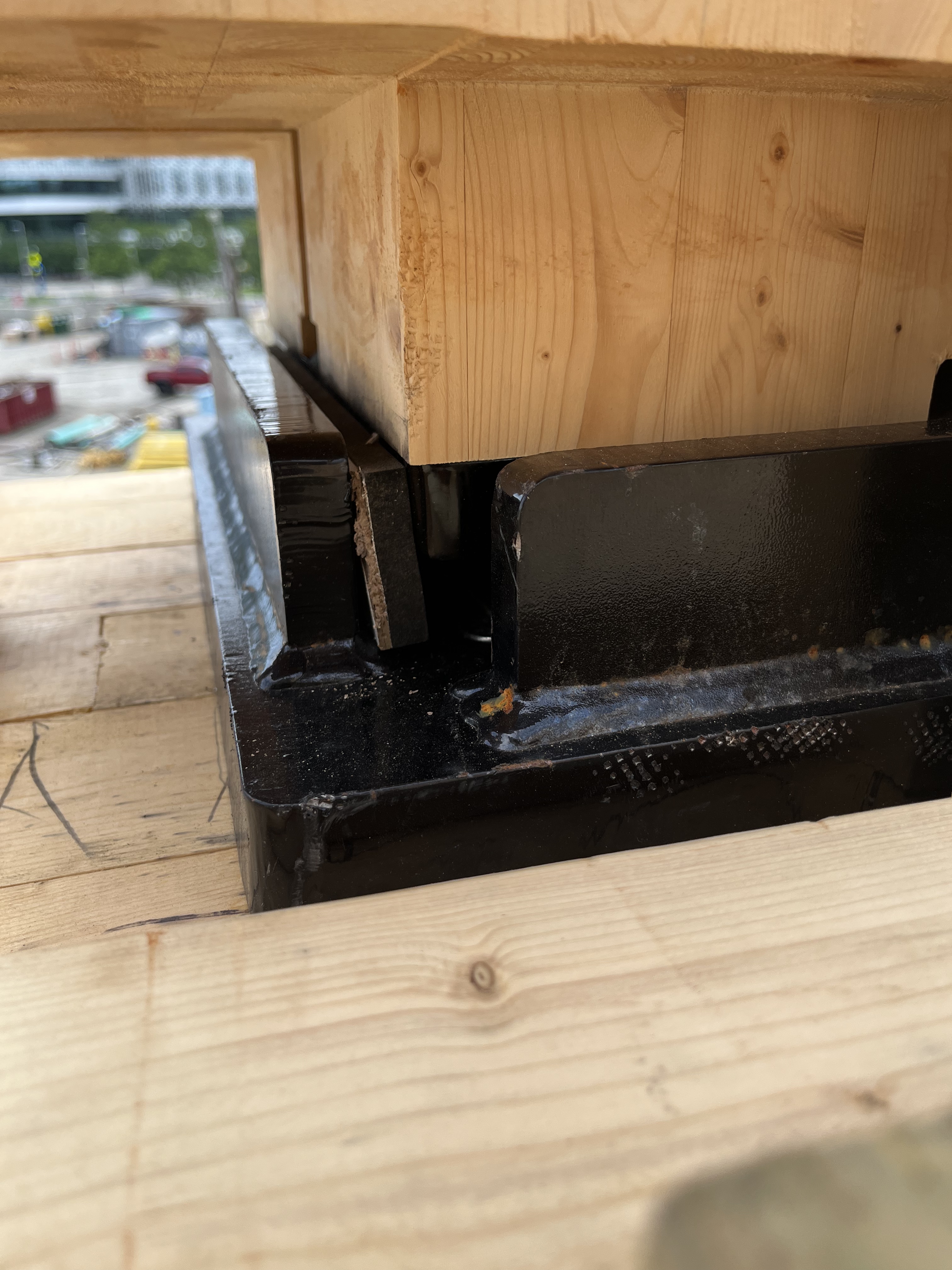
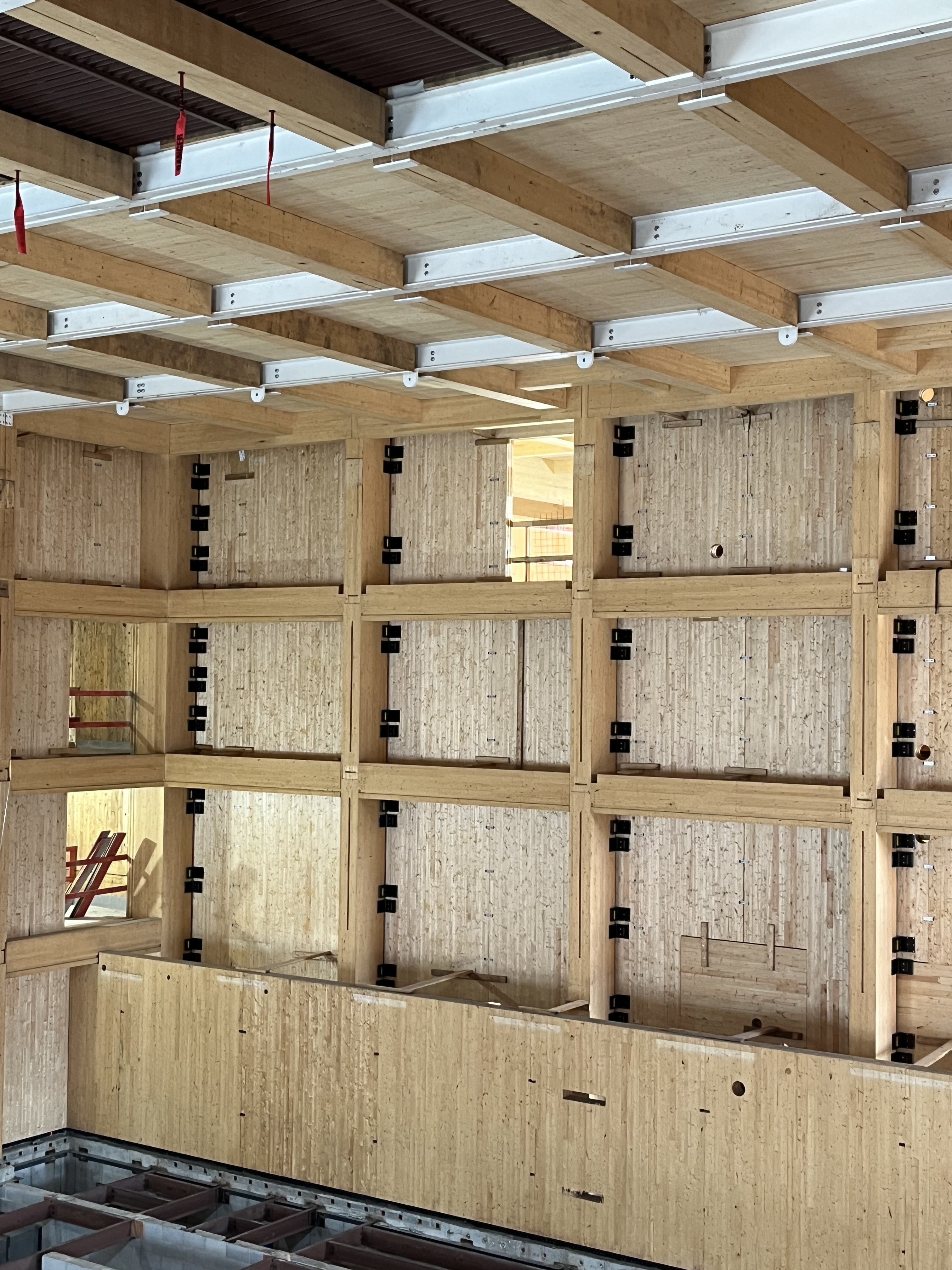
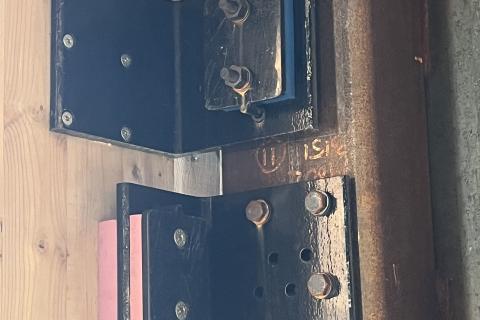
Custom-engineered elastomeric bearings were developed for critical structural interfaces, including column assemblies, façade fixations, and isolated CLT chimney wall panels. The final system employed a hybrid isolation strategy that balances acoustic performance and structural behavior across varying load conditions.
Under normal operating loads, the primary elastomeric bearing provides effective acoustic decoupling between building volumes. Under rare extreme loading conditions, such as exceptional snow loads, a secondary, stiffer element engages to limit deflection and protect the structural system. This approach ensured predictable structural behavior while maintaining acoustic performance for typical use conditions.
To validate both performance and constructability, CDM Stravitec supported full-scale mockups of critical connections prior to site installation. These mockups informed refinements to detailing, tolerances, and installation sequencing, improving constructability and reducing on-site risk.
Rather than supplying a preconfigured product, CDM Stravitec delivered a custom-engineered isolation strategy tailored to the project’s structural constraints, acoustic performance targets, and construction timeline.